Tuesday, June 10, 2008

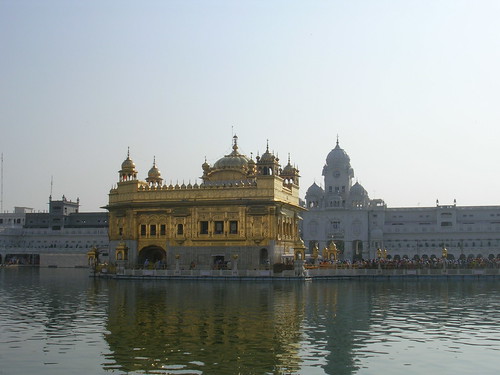
Golden Temple, Amritsar, India


India Trip, originally uploaded by sunpreet28.

The Golden Temple is the ultimate Sikh pilgrimage. The Harmandir Sahib, as it is traditionally known, actually means the temple of Hari or the Supreme God. Also known as the Darbar Sahib, the stupendous, architectural phenomena is located at the city of Amritsar. The temple's exterior is gold-plated and the structure stands in the middle of a square tank. There is a causeway across the Pool of Nectar to reach the Temple. The shrine is symbolical of the doctrines of Sikhism. It also represents the magnificent strength of all the Sikhs. The amazing thing about Harmandir Sahib is that it has doorways on all four sides, meant to be open for the people of the all four castes. All over the, the Sikhs always look forward to visit to the magnificent temple and offer prayers at the Harmandir Sahib.

The study of the art and architecture of the Golden Temple has, unfortunately, remained a subject of unconcern for art historians and critics. Even scholars of Indian temple architecture have bypassed it and references, whenever made, were mere courtesies. Fergusson considered the Golden Temple an example of the forms, which Hindu temple architecture assumed in the nineteenth century. According to the official list of buildings of interest, published by the Punjab Government in 1875, the design of the temple, as reconstructed by Ranjit Singh, was borrowed from the shrine of Saint Mian Mir, near Lahore. Louis Rousselet, writing in 1882, regarded it as a "handsome style of architecture". Major Cole described it as an adaptation of Mohammadan styles, flavoured with a good deal of Hindu tradition. Percy Brown considered it to be a product of the synthesis of Hindu and Muslim influences, combined with elaborations that imparted it an appearance of its own.

Guru Arjan Dev thought of building a central place of worship for the Sikh community. In 1588, after finalizing the design of the Darbar Sahib, he laid down the foundation of the temple himself. His followers started living in the adjacent area and the town of Ramdaspur came up. The town of Ramdaspur later came to be known as Amritsar, deriving its name from the holy pond that beautifies the area surrounding Hari Mandir. The planning to dig the holy tank or Amrit Sarovar was made by Guru Amar Das. However, the construction of the tank took place under the supervision of Baba Budha ji. The land for the site was acquired free of cost from the zamindars (landlords) of native villages. The first Sikh Maharaja Ranjit Singh made Amritsar his spiritual capital. He developed the temple further including the gilding of the embossed plates, renewing of the pietra dura and the embellishment of the ceilings with the mirror and floral designs.

Amritsar is an institution by itself. And the Golden Temple is the cradle of Amritsar with the city growing around it nurtured by its divine sanctity. The Golden Temple stands there in simple majesty, the gilded splendor of its paneling, dome and minarets shining in the morning light, silhouetted softly in the water and etched gently across the city escape. For the Sikh community the Harmandir Sahib Gurdwara Golden Temple is the final spiritual "vision," journey's end or beginning and, for every other community too, it is a shrine to be visited.

Besides the Golden Temple there are several other Gurudwaras in India that are of great importance to the pilgrims. Another important pilgrimage site is Anandpur Sahib, where Guru Gobind Singh, the tenth Guru created the 'Khalsa' or the pure ones by baptizing them. Anandpur Sahib (in Ropar District) is one of the five Sikh takhts or thrones. Sikhs from all over India visit this holy site especially on the occasion of Holla Mohalla which coincides with the last day of Holi and marks the festival's finale. On this day, the Gurudwara Keshgarh is filled with people and colour as men in bright turbans and women in gaily-colored salwar kameezs try to live up to Guru Gobind Singh Ji's vision of Holi.

Planning a pilgrimage to any of the Gurudwaras of India? Check out the following all-inclusive tour packages and holiday offers that will make your travel trip to the Gurudwara tour comfortable and enjoyable. We provide a range of tour packages and holiday offers for the destinations with sacred Gurudwaras of India that will suit your requirements and budget. As per the nature, duration and the accommodation required during the pilgrimage at each destination of the Gurudwara the tour packages vary.

Manali and Manikaran


Manali and Manikaran, originally uploaded by sunpreet28.

History

Manali has a pre-historic legend behind its name. Vaivasvata, the seventh incarnation of Manu, the first creation according to Hindu mythology, found a tiny fish in his bathing water. The fish told him to look after it with devotion, for one day it would do him a great service. The seventh Manu cared for the fish until it grew so huge that he released it into the sea. Before departing, the fish warned Manu of an impending deluge when the entire world would be submerged and bade him to build a seaworthy ark. When the flood came, Matsya (fish), the first avatar of Lord Vishnu, towed Vaivasvata and the Seven Sages to safety. As the waters subsided, the seventh Manu's ark came to rest on a hillside and the place was named Manali after him.

Introduction

Manali is an important hill station of northern India and is the destination of thousands of tourists every year.Manali derived its name from Manavalaya meaning the abode of Manu or "Home of Manu" and here, the temples are treated as pilgrimages. Its cool atmosphere provides a perfect haven for the ones afflicted by the hot Indian summers. Manali is also famous for adventure sports like skiing, hiking, mountaineering, para gliding, rafting, trekking, kayaking, and mountain biking.

Location

Manali is situated in the central parts of Himachal Pradesh, Manali is 32 km from Kullu valley, 280 km north of the state capital Shimla and 108 km from Mandi. Manali is located at an altitude of 2050 meters above sea level and is spread along the banks of the river Beas.

Weather

In winters, the temperature can drop below freezing point when heavy woolens are required. Summer temperatures are mild and light woolens/cottons are recommended. In Manali, one can find high mountains shrouded by silent snows and deep boulder strewn gorges. There are thick forests, filled with cool breezes and bird song.

Places to see

Arjun Gufa

On the left bank of the river Beas, near Prini village, is the "Arjun Gufa" or the cave of Arjuna. It is believed that Arjuna practiced austerities to get Pashupata Ashtra or weapon from Lord Indra.

Hadimba Temple

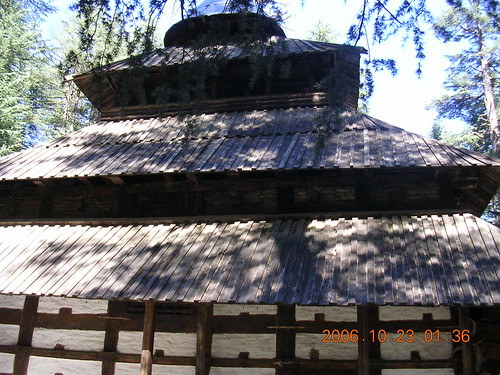
Built in 1553, this four-story wooden Hadimba or Dhungiri temple is famous for its exquisitely caved doorway. It is located in the middle of a forest called the Dhungiri Van Vihar.

Jagatsuhk

About 6 kms. from Manali is the famous Shiva Temple in "shikara" style. It houses temples dedicated to Lord Shiva and Sandhya Gayatri.

Kothi

This is a quiet but picturesque spot, at the foot of the Rohtang pass, 12 kms. away from Manali town. It offers a magnificent view of the snow-capped peaks and glaciers.

Manu Temple

Manali is named after the sage Manu who was the creator of human race on the earth and it is believed that he meditated here. This is supposed to be the only temple of Manu in India.

Monasteries

Manali is known for its shiny gompas or Buddhist monasteries. It is maintained by donations from the local community and by sale of hand-woven carpets in the temple workshop.

Rahala waterfalls

About 16 km from Manali at the start of the climb to the Rohtang Pass, are the beautiful Rahalla Falls at an altitude of 2,501 m.

Rohtang Pass

(3979 m)Rohtang Pass is the highest point on the Manali-Keylong road. It provides a wide panoramic view of mountains rising far above clouds, which is truly a breath taking sight.

Solang Valley

Solang valley offers the view of glaciers and snow capped mountains and peaks. It has fine ski slopes. The Mountaineering Institute has installed a ski lift for training purpose. The 12-km hike up the western banks of the Beas to the Solang Valley is noteworthy.

Vashist Hot Water Springs and Temple

(3 kms)Across the Beas river is Vashist, a small village with natural sulphur springs. Modern bathhouses, with Turkish-style showers, have the hot water piped into them for the convenience of the visitors who come here to benefit from the medicinal properties. There is a pyramidal stone temple dedicated to Vashist Muni and another Temple of Lord Ram.

Friday, June 6, 2008

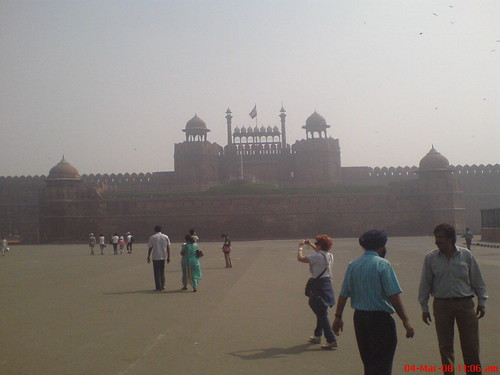
Red Fort, New Delhi, India


india trip march 2008, originally uploaded by sunpreet28.

The Delhi Fort also known as Lal Qil'ah, or Lal Qila, meaning the Red Fort, located in Delhi, India is a UNESCO World Heritage Site.[1]

History

The main facade of the fortThe Red Fort and the city of Shahjahanabad was constructed by the Emperor Shah Jahan in 1639 A.D. The layout of the Red Fort was organised to retain and integrate this site with the Salimgarh Fort. The fortress palace is an important focal point of the medieval city of Shahjahanabad. The planning and aesthetics of the Red Fort represent the zenith of Mughal creativity which prevailed during the reign of Emperor Shahjahan. This Fort has had many developments added on after its construction by Emperor Shahjahan. The significant phases of development were under Aurangzeb and later Mughal rulers. Important physical changes were carried out in the overall settings of the site after the First War of Independence during British Rule in 1857. After Independence, the site experienced a few changes in terms of addition/alteration to the structures. During the British period the Fort was mainly used as a cantonment and even after Independence, a significant part of the Fort remained under the control of the Army till the year 2003.

The Red Fort was the palace for Mughal Emperor Shah Jahan's new capital, Shahjahanabad, the seventh Muslim city in the Delhi site. He moved his capital from Agra in a move designed to bring prestige to his reign, and to provide ample opportunity to apply his ambitious building schemes and interests.

The fort lies along the Yamuna River, which fed the moats that surround most of the wall. The wall at its north-eastern corner is adjacent to an older fort, the Salimgarh Fort, a defense built by Islam Shah Suri in 1546. Construction on the Red Fort began in 1638 and was complete by 1648. However, it is believed that it is the ancient city of Lal Kot which was captured by Shah Jahan since Lal Kot literally means Red (Lal) Fort (Kot). Lal Kot was the capital city of Prithviraj Chauhan in the late 12th century.

On 11 March 1783, Sikhs entered Red Fort in Delhi and occupied the Diwan-i-Am. The city was essentially surrendered by the Mughal wazir in cahoots with his Sikh Allies. This task was carried out under the command of the Sardar Baghel Singh Dhaliwal of the Karor Singhia misl.


[edit] Dimensions
The Red Fort stands at the eastern edge of Shahjahanabad, and gets its name from the massive wall of red sandstone that defines its four sides. The wall is 1.5 miles (2.5 km) long, and varies in height from 60ft (16m) on the river side to 110 ft (33 m) towards the city. Measurements have shown that the plan was generated using a square grid of 82 m.


[edit] Architectural Design

View of the buildings in the courtyardRed Fort showcases the very high level of art form and ornamental work. The art work in the Fort is a synthesis of Persian, European and Indian art which resulted in the development of unique Shahjahani style which is very rich in form, expression and colour. Red Fort, Delhi is one of the important building complexes of India which encapsulates a long period of Indian history and its arts. Its significance has transcended time and space. It is relevant as a symbol of architectural brilliance and power. Even before its notification as a monument of national importance in the year 1913, [[efforts were made to preserve and conserve the Red Fort, for posterity.]]

The walls of the fort are smoothly dressed, articulated by heavy string-courses along the upper section. They open at two major gates, the Delhi and the Lahore gates. The Lahore Gate is the main entrance; it leads to a long covered bazaar street, the Chatta Chowk, whose walls are lined with stalls for shops. The Chatta Chowk leads to a large open space where it crosses the large north-south street that was originally the division between the fort's military functions, to its west, and the palaces, to its east. The southern end of this street is the Delhi Gate.


[edit] Important Buildings Inside Fort

[edit] Naqqar Khana
On axis with the Lahore gate and the Chatta Chowk, on the eastern side of the open space, is the Naqqar Khana ("drum house"), the main gate for the palace, named for the musicians' gallery above it.


[edit] Diwan-i-Aam
Beyond this gate is another, larger open space, which originally served as the courtyard of the Diwan-i-Aam, the large pavilion for public imperial audiences. An ornate throne-balcony for the emperor stands at the center of the eastern wall of the Diwan.


[edit] Nahr-i-Behisht
The imperial private apartments lie behind the throne. The apartments consist of a row of pavilions that sits on a raised platform along the eastern edge of the fort, looking out onto the river Yamuna. The pavilions are connected by a continuous water channel, known as the Nahr-i-Behisht, or the "Stream of Paradise", that runs through the center of each pavilion. The water is drawn from the river Yamuna, from a tower, the Shah Burj, at the northeastern corner of the fort. The palace is designed as an imitation of paradise as it is described in the Koran; a couplet repeatedly inscribed in the palace reads, "If there be a paradise on earth, it is here, it is here". The planning of the palace is based on Islamic prototypes, but each pavilion reveals in its architectural elements the Hindu influences typical of Mughal building. The palace complex of the Red Fort is counted among the best examples of the Mughal style.


[edit] Zenana
The two southernmost pavilions of the palace are zenanas, or women's quarters: the Mumtaz Mahal (now a museum), and the larger, lavish Rang Mahal, which has been famous for its gilded, decorated ceiling and marble pool, fed by the Nahr-i-Behisht.


[edit] Khas Mahal
The third pavilion from the south, the Khas Mahal, contains the imperial chambers. These include a suite of bedrooms, prayer rooms, a veranda, and the Mussaman Burj, a tower built against the fortress walls, from which the emperor would show himself to the people in a daily ceremony.


[edit] Diwan-i-Khas
The next pavilion is the Diwan-i-Khas, the lavishly decorated hall of private audience, used for ministerial and court gatherings. This finest of the pavilions is ornamented with floral pietra dura patterns on the columns, with precious stones and gilding. A painted wooden ceiling has replaced the original one, of silver inlaid with gold.

The next pavilion contains the hammam, or baths, in the Turkish style, with Mughal ornamentation in marble and colored stones.


[edit] Moti Masjid
To the west of the hammam is the Moti Masjid, the Pearl Mosque. This was a later addition, built in 1659 as a private mosque for Aurangzeb, Shah Jahan's successor. It is a small, three-domed mosque in carved white marble, with a three-arched screen which steps down to the courtyard.


[edit] Hayat Bakhsh Bagh
To its north lies a large formal garden, the Hayat Bakhsh Bagh, or "Life-Bestowing Garden", which is cut through by two bisecting channels of water. A pavilion stands at either end of the north-south channel, and a third, built in 1842 by the last emperor, Bahadur Shah Zafar, stands at the center of the pool where the two channels meet.


[edit] The Fort Today

The Red Fort by night.The Red Fort is one of the most popular tourist destinations in Old Delhi, attracting thousands of visitors every year. The fort is also the site from which the Prime Minister of India addresses the nation on August 15 , the day India achieved independence from the British. It also happens to be the largest monument in Old Delhi.

At one point in time, more than 3,000 people lived within the premises of the Delhi Fort complex. But after the Sepoy Mutiny of 1857, the fort was captured by Britain and the residential palaces destroyed. It was made the headquarters of the British Indian Army. Immediately after the mutiny, Bahadur Shah Zafar was tried at the Red Fort. It was also here in November 1945, that the most famous courts-martial of three officers of the Indian National Army were held. After India gained independence in 1947, the Indian Army took control over the fort. In December 2003, the Indian Army handed the fort over to the Indian tourist authorities.

The fort was the site of a December 2000 attack by terrorist group Lashkar-e-Toiba which killed two soldiers and one civilian in what was described in the media as an attempt to derail the India-Pakistan peace process in Kashmir.


I went to India gate in March of 2008. Ticket is Rs. 25 for Indians and more for foreigners. The security at Red fort is very tight and there are so many shops inside the fort. They sell all kinds of souvenirs. It is quite not a lot of Indian people. All you see is foreigners. Indians don’t bother to go there. When I went there in the afternoon it was all empty except that you will see some couples sitting under trees and on the corners of the forts. There is not much to see in the fort; it's not even well maintained. I didn’t like it and I think Agra fort is way better than it and has more tourists visiting it.
There is a small museum in it and the ticket price includes the visit. It is close to chandni chownk area of old Delhi. There are some other things close by that must be visited like Jama Masjid. It's very crowded and almost all the tourists go visit the fort and old Delhi.

Thursday, June 5, 2008

Mandi, Himachal Pardesh, India


Himachal Pardesh, India, originally uploaded by sunpreet28.

Mandi (old name Mandav Nagar) is a city and a municipal council in Mandi district in the Indian state of Himachal Pradesh. (Legend has it that the Great sage 'Mandav' prayed in this area, and the rocks turned black due to the severity of his penance, the town was referred to as Mandvya Nagari in his honour.).


The River Beas where it runs through the city of Mandi, Himachal Pradesh.

[edit] Geography
Mandi is located at 31.72° N 76.92° E[1]. It has an average elevation of 1044 metres (3425 feet). It is built on the Banks of the Beas River. [1]


View of Mandi Town
[edit] Demographics
As of 2001 India census[2], Mandi had a population of 26,858. Males constitute 53% of the population and females 47%. Mandi has an average literacy rate of 84%, higher than the national average of 59.5%: male literacy is 86%, and female literacy is 82%. In Mandi, 10% of the population is under 6 years of age.


[edit] Miscellany

Princely flag of MandiMandi has mixed population,Hindus,Sikhs,Muslims and Christians live together in harmony. The people are religious, secular, broadminded and warmhearted. All celebrate Indian festivals together with great zest.

[edit] Temples

Bhimakali TempleMandi has more than 300 old and new temples. Because of large number of temple sand its location along River Beas Mandi is also known as Chhoti(Small) Kashi. Most of the temples are dedicated to Lord Shiva and Goddess Kali. There are many classical temples which the Archaeological Survey of India has declared as 'protected monuments' due to there historical significance, the primary ones being:Panchvaktra Temple, situated at the confluence of River Beas and Suketi khad.Ardhnareshwar Temple, which is one of the very few temples in India.Triloknath Temple located on the right bank of river Beas.

Gurudwara
Mandi has a grand historical Gurudwara Gobind Singh in honour of Guru Gobind Singh who spent some time in Mandi. The people and the ruler welcomed with great warmth and supported Guru in his war against the tyrannical rule of Aurangzeb; it is said that the Town has Guru's blessings.(the Gurdwara is also unofficially referred to as Gurudwara PalangSahab, because Guru's Bed 'Palang' is still preserved here)


[edit] Places to be seen

A view of the Sunken Garden otherwise known as GhantagharSunken Garden(Indira Market)
Tarna Temple also called Shyama Kali temple
Bhima Kali Temple
Panchvaktra Temple
Panchvakra an ancient temple of Lord Shivakangri dhar
Over the years the town has become crowded. Watch out for cars and autorickshaws (and stray cows too).

Mandi is also famous for the Shivratri an International festival held for seven days in the month of March every year. Mandi town hosts a half marathon every year.Mandi is the gateway to the Kulu valley. The best place to watch near by is Sunder Nagar which hosts critical pin in the chain of Bhakhra Dam. The Satluj and Beas riviers meet here and from here, are routed towards Gobind Sagar lake which is fed to the Bhakhra Dam(the highest gravity dam in the world). The scene near the gates lake is heavenly.

Tourist Places

[edit] Rewalsar
About 25 km from Mandi, 14 km from Ner Chownk is the Rewalsar lake, famous for its floating islands of reed. It is believed that all seven of them can be moved by prayer or breeze. There are three shrines here, a Buddhist Monastery, where elaborate rituals are performed, a Sikh Gurudwara and a Hindu Temple. It was from this place that the sage Padma Sambhava, a zealous teacher of Buddhism, left as a missionary to preach the doctrine of "the enlightened" in Tibet. Lying in a mountain hollow, the lake is held sacred to all three communities, boating facilities are available. Tourist inn maintained by HPTDC provide accommodation and Indian cuisine. can also go to naina sar and temple which have historic idols


[edit] Prashar
This lake lies 40 k.m. north of Mandi, with a three storied pagoda like temple dedicated to the sage Prashar.


[edit] Joginder Nagar
The large hydro-electric project in Jogindernagar is a living tribute to man he has harnessed and tamed the wild and roaring river for his betterment. Here an electric trolley takes the visitor up the steep, rocky face of 2,500 metres-high (8,202 ft) mountain and drops sharply on the other side to Barot, where the reservoir is located.

The railway line goes up to the power station, the water rushing down from the reservoir at Barot in the Uhl river through penstock pipes going down nearly a thousand metres(3,280 ft). For tourists who go up to Barot by the trolley, there is a comfortable rest house of the Electricity department. The roads extends beyond to Mandi and passes the Larji gorge to the Kullu valley.

Bassi power station is five kilometres from Jogindernagar and next to it, is Machinhar where fishing is not permitted as it is considered a sacred spot, but it is a popular as a feeding spot for fish.


[edit] Sunder Nagar
Famous for its temples, 26 km from Mandi towards Shimla and at a height of 1,174 metres on the raised edge of a fertile valley, the beautiful town of Sundernagar is known for its shady walks amidst towering trees. On top of a hill and visited by thousands of devotees every year, is the Sukhdev Vatika and temple of Mahamaya.

The biggest hydro-electric project in all Asia, the Beas-Sutlej project, irrigating nearly one-fourth of the northern plains of India, has brought unprecedented prosperity to Sundernagar. The Beas-Sutlej link colony is the biggest colony in Himachal Pradesh.


[edit] Janjehli
At a distance of 67 km from Mandi, Janjehli is a paradise for hikers, offering treks up to a height of 3,300 metres. After covering 32 km by a motorable road up to Gohar and rest of the journey is on foot. In the midst of thick forest, forests (15 km from Gohar) is Bajahi. There is a beautiful and well furnished rest house to stay overnight, from here Janjehli is a scant 20 km away through bridle path. chindi and karsog are also nice places for meditation

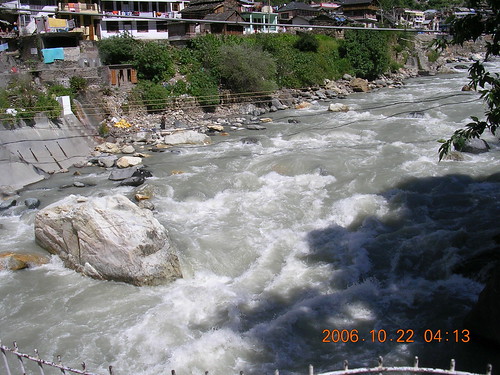
Manali and Manikaran


Manali and Manikaran, originally uploaded by sunpreet28.

Manali is famous for its snow covered peaks, Skiing and the Rohtang pass. My wife and I had decided that Manali would be our next destination after Shimla. The time was February. We decided to reserve HPTDC’s hotel in Manali for us.

We checked out from our hotel in Shimla by evening and they arranged porters to carry our luggage to the bus stand. I want to add one word of appreciation for the porters of Shimla. I saw them carry almost everything on their back from gas cylinders, rice sacks, oil cans, wood, stones, etc to an Almirah!!! And with all the heavy weight on their backs and head, they climb the thousands of steps from lower Shimla to upper Shimla. Kudos to them for their help to tourists like us!

We boarded the bus from the bus stand in lower Shimla. The bus was 2*2 deluxe. The seats were very cramped and we had a tough time squeezing ourselves in. There was very little leg room and when we tried to push back our seats, it was touching the chest of my co-passenger behind me. So we had to sit upright all through our journey. The bus left by 8:30 pm from Shimla. The journey was bone rattling and we couldn’t sleep because of the engine noise and the bumpy ride.

We reached Manali by 5 am. We had kept our window closed because of the cold wind. It was quite warm and comfortable inside the bus. But when we got out of the bus, we were shocked by the biting cold. It was freezing out there and we were chilled to the bone in an instant. The city was still asleep and all we could see were some autos. The hotel is located on the banks of the River Beas. The room was very spacious and tidy and we settled down for some much needed sleep.

That morning we woke up late and were amazed by the view we got from the window. There was snow outside our room and we could see river Beas and the mighty Himalayas covered in a blanket of snow. We then went to the city. It is called the Mall, but much smaller than the Mall in Shimla. There were lots of restaurants and the food was very good. There are not many fancy restaurants in Manali. We then went to a Buddhist temple near the Mall. It was very beautiful. We spent the rest of the day shopping and exploring the town. We booked a tour of HPTDC for the next day.

We left Manali the next day by 9am for the tour. There were 2 other couples with us and our vehicle was a Sumo. We first went to Solang valley, about 14 kilometers away. It is famous for skiing and Paragliding. On the way we saw shops renting out fur coats and gloves and boots. They warned us that if it snows there, then temperature will drop below zero. We rented the equipment and carried on. The view was simply breathtaking. There were so many mountains all around us. We crossed river Beas many times and finally reached the base point of Solang valley. From there we had to trek up the mountain to reach the valley. We were happy that we rented rubber boots, as the way up was very dirty because of the melting snow.

The valley was beautiful with slopes perfect for skiing. We saw many people trying their luck in paragliding. But we avoided it as I had heard earlier that the winds can change anytime and then it can be dangerous. We took photos wearing the traditional dress of Himachal and my wife looked very beautiful in the bridal dress once again! We spent time trekking the slopes and playing with ice. There was actually no need for the fur coats as it was not very cold. Do remember to carry sun glasses and sun cream. We could not go to Rohtang pass as the whole are was covered with 25 feet of snow. Can you imagine? 25 feet!

Our next stop was Hadimba temple. We had seen the temple in many movies and were thrilled to see it. This temple is wooden and the deity is goddess Hadimba. The temple is surrounded by thousands of deodar trees. The setting was perfect for a romantic movie song. We were told that the temple was built on top of a natural cave which has a foot-print believed to be of goddess Hadimba. We also saw rabbits and yaks there. We have to pay to be photographed with them. We were also told that they make shawls from rabbit fur. I never saw any, though!

We then visited Vashishtha temple about 3 kilometers from Manali. Vashishtha is famous for hot sulphur water springs. The locals believe that diseases will be cured if a person takes a dip in these springs. We returned to Manali in the evening and spent some time catching up with our friends on the internet. We also booked the Manikaran tour of HPTDC for the next day.

We left early in the morning for Manikaran, which is a 90 kilometer drive. Manikaran is famous for its hot water springs and a Gurudwara and two temples existing sided by side. Do we need another example for communal and religious harmony?

There were around 15 more couples with us this time. We were taken in a deluxe bus and we felt much safer. We got the first two seats right behind the driver. The roads were terrifying and there were countless hairpin curves and blind turns. Our driver was an expert and slowly I relaxed seeing his technique. The place was very beautiful with thousands and thousands of deodar trees and river Parvati was flowing with its full might. Our bus was parked a long way away from the temple due to road work.

We could see lots of small pools of boiling hot springs inside the temple. People were cooking rice in the hot water. I was told that rice cooks in 20 minutes in the hot spring water. There is a bigger bathing area inside the Gurudwara. One thing I do not like about temples is that we have to remove our shoes and I wouldn’t trust anyone with my comfy and attractive sports shoes.

We then visited Kullu valley. We saw Vaishno Devi Temple, and it lies on the national highway about 2 kilometers from Kullu town. We were told that there are a total of 368 temples in Kullu.

We then went to Naggar and visited the Roerich Art Gallery. Nicholas Roerich was a Russian painter, and he had settled in Kullu valley at Naggar. The beauty of Kullu valley enchanted him. He bought a piece of land from the king of Mandi and named it named ’Hall Estate’. He built his residence there. Roerich spent the rest of his life in Naggar. The ground floor of his residence has now been converted in to an art gallery where his paintings of the Himalayas are displayed. This art gallery was founded in 1962 by his son, Svyetoslav Roerich. It is now renamed as Roerich Heritage Museum. This museum is a must visit place. The most striking work was a painting of actress Devika Rani. The painting felt alive.

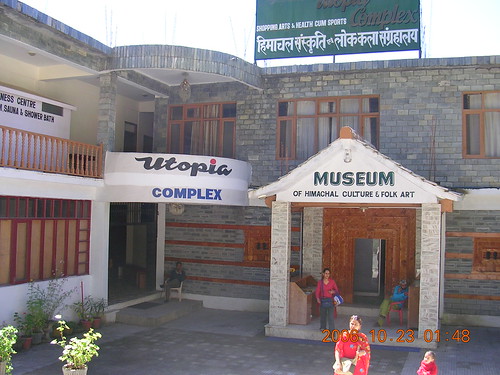
We then visited Urusvati Himalayan Folk Art Museum, which is located in the same premises as Roerich Art Gallery. It is about 100 meters uphill trek to the museum from the art gallery. The view was amazing and the path was cobbled and there were benches on the way for people to rest. The whole area is covered by deodar trees. We could see lots of paintings, puppets with different national costumes, musical instruments, etc in the museum. The museum is definitely a national treasure.

We returned back to Manali with a heavy heart. We did not want to leave. Everything was so beautiful. We wanted to stay for some more days, but we had to explore more places. We left for Delhi by bus. Manali is one of the most beautiful places in the world.

Manikaran Gurudwara


Manali and Manikaran, originally uploaded by sunpreet28.

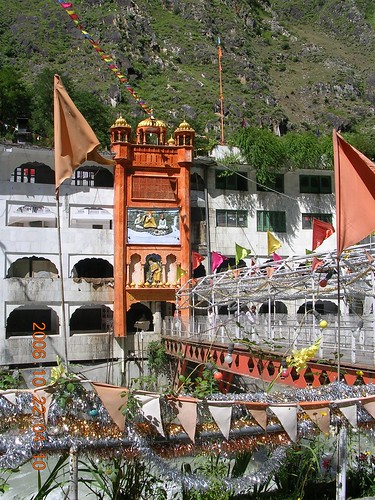
Manikaran is located in the Parvarti Valley which runs N/E from Bhuntar in the Kulu district of Himachal Pradesh. It is famous for its sulpher hot springs, its numerous temples and its beautiful surroundings. The Hindus believe that 'Manu' recreated human life in Manikaran after the flood, hence the sacredness of the town and the rest of the area. Lord Shiva also had connections here with his bride Parvarti's temple located on the steep hillside (which is also a good place to view the Dio Tibba Glacier, 6001m). A good place for hikers to stay for a few days and catch their breath and get warm in one of the baths before trecking

I went to Manikaran from Mandi with my cousins. It was nice experience. We went on jeep which was convertible. It had no hood and we enjoyed the beautiful landscapes. We stopped at bhunter for MOMOS. They love to eat MOMOS and soup. We reached there at night time and the roads were all empty. When you get close to Manikaran the road gets too narrow that only one vehicle can pass. We were little bit scared at night, as my cousins from Mandi were scaring me that wild animals do attack at night. We reached there at 10 PM. my brother got the room in the Gurudwara and we rested for the night. One can hear the roaring sound of water flowing beside the Gurudwara. In the morning we went to see the market and Lord Shiva temple, as well as other things near by. It is very beautiful and one must visit this Gurudwara.

Manali and Manikaran


Manali and Manikaran, originally uploaded by sunpreet28.

The hill station of Manali, located at an altitude of 2000 meters in the picturesque state of Himachal Pradesh is well known. We decided to get a feel of this extremely popular weekend getaway spot. The month of April, when we visited Manali, marks the end of the long and snow-dominated winter season. By this time, the snow has bid adieu to the town of Manali and is present only on the upper reaches on the way to Rohtang pass. However, the Rohtang pass still remains inaccessible and can be assessed only from mid-May onwards. While tourists like us from the furnaces of Mumbai may find the weather a bit chilly, the locals find it most pleasant and the best time for exploring the outdoors. From the tourism point-of-view, April is an off-season, being exam-time throughout the country. It is also that time of the year when the apple trees, the lifeline of Himachal, is at the peak of its flowering cycle.

Our son had just finished writing his Xth Std exams and this was the just the break we were longing for, after an extremely stressful year. The flight from Delhi to the Bhuntar airstrip at Kullu takes just an hour. Only Deccan and Jagson Airlines operate single daily flights to Kullu and we had taken the former. The airport of Kullu has a fairy-tale look to it with the gushing Beas flowing alongside. The Beas River was to keep us company almost everywhere we went during our sojourn. The Himachal Taxi Operator’s counter is the only car hiring option at Kullu airport, but is operated very efficiently at fixed pre-determined rates.

It would be a cliché to say that the drive to Manali was fascinating. With the Beas rapidly flowing on one side, the uphill and winding path is flanked with apple trees, over-laden with white blossoms. It takes an hour-and-half to reach Manali, from Kullu. We stopped for lunch on the way at a beautiful hill-side hotel. The Club Mahindra Snow Peaks Resort looks very ordinary and nondescript from the outside but has rooms that are all facing the north, each providing extremely awesome views of the snow-clad Himalayan peaks. As we stepped into our room, we were stunned by the view that accosted us. The man at the reception had said that he was giving us the best room they had to offer and we had instantly dismissed it as mere marketing talk. The glistening snow-clad peaks left us transfixed and frozen in our tracks. Cold and aloof, the Himalayas just stood there- stately, lofty, pompous and in regal splendour.

Tuesday, June 3, 2008

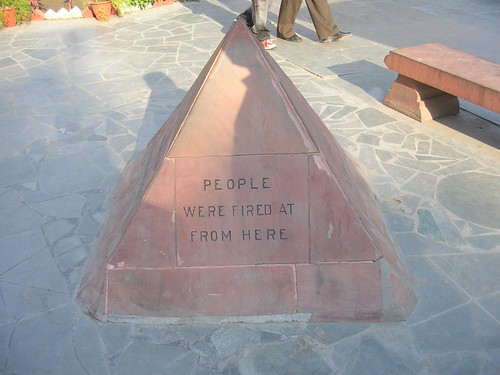
The Jallianwala Bagh, Amritsar, India


India Trip, originally uploaded by sunpreet28.

The Jallianwala Bagh Massacre, also known as the Amritsar Massacre, was named after the Jallianwala Bagh (Garden) in the northern Indian city of Amritsar.
Background

India during World War I
Main article: Ghadar Conspiracy
World War I began with an unprecedented outpouring of loyalty and goodwill towards the United Kingdom from within the mainstream political leadership of India, contrary to initial British fears of a revolt. India contributed massively to the British war effort by providing men and resources. About 1.3 million Indian soldiers and labourers served in Europe, Africa, and the Middle East, while both the Indian government and the princes sent large supplies of food, money, and ammunition. However, Bengal and Punjab remained hotbeds of anticolonial activities. Terrorist style attacks in Bengal, increasingly closely linked with the unrest in Punjab, were significant enough to nearly paralyse the regional administration.[1][2] Also from the beginning of the war, expatriate Indian population, notably from United States, Canada, and Germany, headed by the Berlin Committee and the Ghadar Party, attempted to trigger insurrections in India on the lines of the 1857 uprising with Irish Republican, German and Turkish help in a massive conspiracy that has since come to be called the Hindu German conspiracy[3][4][5] This conspiracy also attempted to rally Afghanistan against British India.[6] A number of failed attempts were made at mutiny, of which the February mutiny plan and the Singapore mutiny remain most notable. This movement was suppressed by means of a massive international counterintelligence operation and draconian political acts (including the Defence of India act 1915) that lasted nearly ten years.[7][8]


After the war
In the aftermath of World War I, high casualty rates, soaring inflation compounded by heavy taxation, a widespread influenza epidemic, and the disruption of trade during the war escalated human suffering in India. Indian soldiers smuggled arms into India to overthrow British rule. The prewar nationalist movement revived as moderate and extremist groups within the Indian National Congress submerged their differences in order to stand as a unified front. In 1916, the Congress succeeded in forging the Lucknow Pact, a temporary alliance with the Muslim League over the issues of devolution of political power and the future of Islam in the region. The costs of the protracted war in both money and manpower were staggering. In India, long the "jewel in the crown" of the British Empire, Indians were restless for independence, having contributed heavily to the war efforts in both money and men. Over 43,000 Indian soldiers had died.


Post-war developments
Indians were expecting, if not freedom, at least more say in their governance; so the Indian Nationalist movement was marked by a clear domination of the more extreme rather than the moderate. In this charged atmosphere, Britain implemented the Montagu-Chelmsford Reforms. However, the provisions of the reforms were unsatisfactory enough for Madame Bhikaji Cama to call them unsuitable for Britain to offer and unworthy for Indians to accept. This brought about further deterioration to an already deteriorating situation in India.


Rowlatt Committee
The events of the Ghadar conspiracy during World War I, the presence of Mahendra Pratap's Provisional Government in Afghanistan and its possible links to Bolshevik Russia, as well as a still active revolutionary movement especially in Punjab and Bengal, and worsening civil unrest throughout India, especially amongst the Bombay millworkers, led to the appointment of a Sedition committee in 1918 chaired by Sydney Rowlatt, an English judge. It was tasked to evaluate German and Bolshevik links to the militant movement in India, especially in Punjab and Bengal.


Rowlatt Act
On the recommendations of the committee, the Rowlatt Act, an extension of the Defence of India act of 1915, was enforced in India.[9][10][11][12] It vested the Viceroy's government with extraordinary powers to quell sedition by silencing the press, including detaining the political activists without trial, arrest without warrant of any individuals suspected of sedition or treason, as well as trial before special tribunals and in camera. The passage sparked massive outrage within India.


Prelude to the massacre
The events that followed the passage of the Rowlatt Act in 1919 were also influenced by the events linked to the Ghadar conspiracy. At the time, British Indian Army troops were returning from the battlefields of Europe and Mesopotamia to an economic depression in India. [13][14] The attempts at mutiny in 1915 and the Lahore conspiracy trials were still in public attention. News of young Mohajirs who fought on behalf of the Turkish Caliphate and later fought in the ranks of the Red Army during the Russian Civil War was also beginning to reach India. The Russian Revolution had also cast its long shadow into India.[15] It was at this time that Mahatma Gandhi, until then relatively unknown on the Indian political scene, began emerging as a mass leader.

Ominously, in 1919, the third Anglo-Afghan war began in the wake of Amir Habibullah's assassination and institution of Amanullah in a system blatantly influenced by the Kabul mission. In addition, in India, Gandhi's call for protest against the Rowlatt act achieved an unprecedented response of furious unrest and protests. The situation especially in Punjab was deteriorating rapidly, with disruptions of rail, telegraph and communication systems. The movement was at its peak before the end of the first week of April, with some recording that "practically the whole of Lahore was on the streets, the immense crowd that passed through Anarkali was estimated to be around 20,000."[14]

In Amritsar, over 5,000 people gathered at Jallianwala Bagh. This situation deteriorated perceptibly over the next few days. Michael O'Dwyer is said to have been of the firm belief that these were the early and ill-concealed signs of a conspiracy for a coordinated uprising around May, on the lines of the 1857 revolt, at a time when British troops would have withdrawn to the hills for the summer. The Amritsar massacre, as well as responses preceding and succeeding it, contrary to being an isolated incident, was the end result of a concerted plan of response from the Punjab administration to suppress such a conspiracy.[16] James Houssemayne Du Boulay is said to have ascribed a direct relationship between the fear of a Ghadarite uprising in the midst of an increasingly tensed situation in Punjab, and the British response that ended in the massacre.[17]

On April 10, 1919, a protest was held at the residence of the Deputy Commissioner of Amritsar, a city in Punjab, a large province in the northwestern part of the then unpartitioned India. The demonstration was held to demand the release of two popular leaders of the Indian Independence Movement, Satya Pal and Saifuddin Kitchlew, who had been earlier arrested on account of their protests. The crowd was fired on by a military picket. The firing set off a chain of violence. Later in the day, several banks and other government buildings, including the Town Hall and the railway station were attacked and set on fire. The violence continued to escalate, culminating in the deaths of at least 5 Europeans, including government employees and civilians. There was retaliatory firing on the crowd from the military several times during the day, and between 8 and 20 people were killed.

For the next two days, the city of Amritsar was quiet, but violence continued in other parts of the Punjab. Railway lines were cut, telegraph posts destroyed, government buildings burnt, and three Europeans were killed. By April 13, the British government had decided to place most of the Punjab under martial law. The legislation placed restrictions on a number of civil liberties, including freedom of assembly, banning gatherings of more than four people [18]


The massacre
On April 13, thousands of people gathered in the Jallianwala Bagh (garden) near the Golden Temple in Amritsar, on Baisakhi, both a harvest and the Sikh religious new year. It was in 1699 during this festival that the tenth Sikh Guru, Guru Gobind Singh created the Khalsa adding the name Singh or Kaur to every Sikh's name. So, for more than two hundred years, this annual festival had drawn thousands from all over India. People had travelled for days, before the ban on assembly.


The Jallianwalla Bagh in 1919, months after the massacre.A group of 90 Indian Army soldiers marched to the park accompanied by two armoured cars. The vehicles were unable to enter the Bagh through the narrow entrance.

The Jallianwala Bagh was bounded on all sides by houses and buildings and had few narrow entrances, most of which were kept permanently locked. Since there was only one open exit, except for the one already blocked by the troops, people desperately tried to climb the walls of the park. Many jumped into a well inside the compound to escape from the bullets. A plaque in the monument says that 120 bodies were plucked out of the well.

As a result of the firing, hundreds of people were killed and thousands were injured. Official records put the figures at 379 killed (337 men, 41 boys and a six-week-old baby) and 200 injured, though the actual figure is hotly disputed to this day. The wounded could not be moved from where they had fallen, as a curfew had been declared.

Back in his headquarters, Dyer reported to his superiors that he had been "confronted by a revolutionary army," and had been obliged "to teach a moral lesson to the Punjab."[citation needed]

In a telegram sent to Dyer, British Lieutenant-Governor of Punjab, Sir Michael O'Dwyer wrote: "Your action is correct. Lieutenant Governor approves."[19]

O'Dwyer requested that martial law be imposed upon Amritsar and other areas; this was granted by the Viceroy, Lord Chelmsford, after the massacre.

Dyer was called to appear before the Hunter Commission, a commission of inquiry into the massacre that was ordered to convene by Secretary of State for India Edwin Montagu, in late 1919. Dyer admitted before the commission that he came to know about the meeting at the Jallianwala Bagh at 12:40 hours that day but took no steps to prevent it. He stated that he had gone to the Bagh with the deliberate intention of opening fire if he found a crowd assembled there.

"I think it quite possible that I could have dispersed the crowd without firing but they would have come back again and laughed, and I would have made, what I consider, a fool of myself." — Dyer's response to the Hunter Commission Enquiry.[citation needed]
Dyer said he would have used his machine guns if he could have got them into the enclosure, but these were mounted on armoured cars. He said he did not stop firing when the crowd began to disperse because he thought it was his duty to keep firing until the crowd dispersed, and that a little firing would do no good.[citation needed]

He confessed that he did not take any steps to tend to the wounded after the firing. "Certainly not. It was not my job. Hospitals were open and they could have gone there," was his response.[citation needed]


Reaction
In the storm of outrage that followed the release of the Hunter Report in 1920, Dyer was placed on the inactive list and his rank reverted to Colonel since he was no longer in command of a Brigade. The then Commander-in-Chief stated that Dyer would no longer be offered employment in India. Dyer was also in very poor health, and so he was sent home to England on a hospital ship.

Some senior British officers applauded his suppression of "another Indian Mutiny". The House of Lords passed a measure commending him. The House of Commons, however, censured him; in the debate, Winston Churchill claimed: "The incident in Jallian Wala Bagh was an extraordinary event, a monstrous event, an event which stands in singular and sinister isolation". Dyer's action was condemned worldwide. He was officially censured by the British Government and resigned in 1920.

However, many Englishmen in India and Britain, as well as the British press, defended Dyer as the man who had saved British pride and honour, some labelling him the "Saviour of the Punjab". The Morning Post started a sympathy fund for Dyer and received over £26,000. An American woman donated 100 pounds, adding "I fear for the British women there now that Dyer has been dismissed."[citation needed] Dyer was presented with a memorial book inscribed with the names of well-wishers. Jawaharlal Nehru, in his autobiography, said he overheard, from his curtained sleeping booth on a night train from Amritsar to Delhi, a military officer in loud voice to another "pointing out how he had the whole town at his mercy and he had felt like reducing the rebellious city to a heap of ashes, but he took pity on it and refrained." It turned out to be Dyer on his way to Delhi after the Hunter Committee meeting. In Delhi, Dyer descended from the train in pyjamas with bright pink stripes and a dressing gown.[20] Nehru also remarked he heard soldiers discussing how the actions taken were a good thing because they would "teach the bloody browns a lesson."

In India, the massacre evoked feelings of deep anguish and anger. It catalysed the freedom movement in the Punjab against British rule and paved the way for Mahatma Gandhi's Non-Cooperation Movement against the British in 1920. It was also motivation for a number of other revolutionaries, including Bhagat Singh. The Nobel laureate Rabindranath Tagore returned his knighthood to the King-Emperor in protest. The massacre ultimately became an important catalyst of the Indian independence movement.


Monument and legacy

Jallianwala Bagh memorial
Entrance to the present-day Jallianwala Bagh.
Bullet marks, visible on a preserved wall, at present-day Jallianwala Bagh.
Wide view of Jallianwala Bagh memorialA trust was formed in 1920 to build a memorial at the site following a resolution passed by the Indian National Congress. In 1923, the trust purchased land for the project. A memorial, designed by American architect Benjamin Polk, was built on the site and inaugurated by the then-President of India, Dr. Rajendra Prasad on 13 April 1961 in the presence of Jawaharlal Nehru and other leaders. A flame was later added to the site.

The bullet holes can be seen on the walls and adjoining buildings to this day. The well into which many people jumped and drowned attempting to save themselves from the hail of bullets is also a protected monument inside the park.

The massacre is depicted in Richard Attenborough's 1982 film Gandhi with the role of Brigadier Dyer played by Edward Fox. It is also depicted in Indian films Rang De Basanti and The Legend of Bhagat Singh.

In 1997, the Duke of Edinburgh, participating in an already controversial British visit to the Monument, provoked outrage in India and in the UK with an offhand comment. Having observed a plaque claiming "This place is saturated with the blood of about two thousand Hindus, Sikhs and Muslims who were martyred in a non-violent struggle.", Prince Philip observed, "That's a bit exaggerated, it must include the wounded". When asked how he had come to this conclusion, Philip said "I was told about the killings by General Dyer's son. I'd met him while I was in the Navy." [21]


Assassination of Michael O'Dwyer
Main article: Udham Singh
On 13 March 1940, an Indian revolutionary from Sunam, named Udham Singh, who had witnessed the events in Amritsar and was himself wounded, shot dead Sir Michael O'Dwyer, believed to be the chief planner of the massacre (Dyer having died years earlier in 1927) at Caxton Hall in London.


Smiling Udham Singh leaving Caxton Hall after his arrestThe action of Singh was generally condemned, but some, like Amrit Bazar Patrika, had different views. The common people and revolutionary circles glorified the action of Udham Singh. Most of the press worldwide recalled the story of Jallianwala Bagh and held Sir Michael O'Dwyer responsible for the tragedy and commended Singh's action. Singh was called a "fighter for freedom" and his action was referred to in the Times newspaper as "an expression of the pent-up fury of the down-trodden Indian People".[22] In Fascist countries, the incident was used for anti-British propaganda: Bergeret, published in large scale from Rome at that time, while commenting upon the Caxton Hall outrage, ascribed the greatest significance to the circumstance and praised the courageous action of Udham Singh.[23] The Berliner Börsen Zeitung called the event "The torch of Indian freedom". German radio reportedly broadcast: "The cry of tormented people spoke with shots."

At a public meeting in Kanpur, a spokesman had stated that "at last an insult and humiliation of the nation had been avenged". Similar sentiments were expressed in numerous other places countrywide.[24] Fortnightly reports of the political situation in Bihar mentioned: "It is true that we had no love lost for Sir Michael. The indignities he heaped upon our countrymen in Punjab have not been forgotten." In its March 18, 1940 issue, Amrit Bazar Patrika wrote: "O'Dwyer's name is connected with Punjab incidents which India will never forget." The New Statesman observed: "British conservativism has not discovered how to deal with Ireland after two centuries of rule. Similar comment may be made on British rule in India. Will the historians of the future have to record that it was not the Nazis but the British ruling class which destroyed the British Empire?"

Singh had told the court at his trial:

"I did it because I had a grudge against him. He deserved it. He was the real culprit. He wanted to crush the spirit of my people, so I have crushed him. For full 21 years, I have been trying to wreak vengeance. I am happy that I have done the job. I am not scared of death. I am dying for my country. I have seen my people starving in India under the British rule. I have protested against this, it was my duty. What a greater honour could be bestowed on me than death for the sake of my motherland?"[25]
Singh was hanged for the murder on July 31, 1940. At that time, many, including Jawaharlal Nehru and Mahatma Gandhi, condemned the action of Udham as senseless. However, later in 1952, Nehru applauded Udham Singh with the following statement which had appeared in the daily Partap: "I salute Shaheed-i-Azam Udham Singh with reverence who had kissed the noose so that we may be free." Having said this, Udham Singh received the title of Shaheed, a name given to someone who has attained martyrdom or done something heroic in the name of their country or religion.[26]

Modern view
Nigel Collett, the author of a new biography of Reginald Dyer, The Butcher of Amritsar [27] said of Dyer: "As an Englishman, I cannot help but feel sorrow and shame at what he did...The massacre was the worst atrocity by a British officer ever recorded".[28]
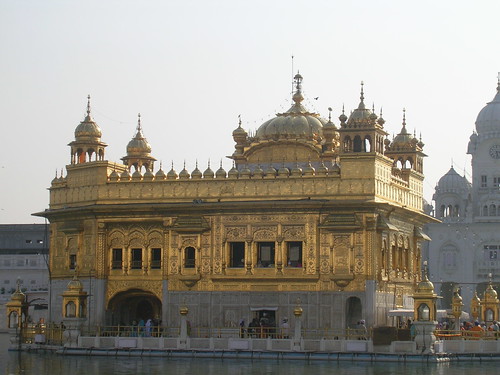
Golden Temple, Amritsar, India


India Trip, originally uploaded by sunpreet28.

The Less I say is Better. I don't want to write anything wrong about this holy place, so here is the description.

The Harmandir Sahib [1](Punjabi: ਹਰਿਮੰਦਰ ਸਾਹਿਬ) or Darbar Sahib[2] (Punjabi: ਦਰਬਾਰ ਸਾਹਿਬ ), informally reffered to as The Golden Temple,[3] is culturally the most significant shrine of the Sikhs and one of the oldest Sikh gurudwara. It is located in the city of Amritsar, which was established by Guru Ram Das, the fourth guru of the Sikhs and is known as "guru di nagri" meaning city of the Sikh Guru.

Harmandir Sahib
Building information
Town Amritsar
Country India
Architect Guru Arjan Dev
Client Guru Arjan Dev & Sikhs
Construction start date December 1585 AD
Completion date August 1604 AD
Style Sikh architecture
Part of a series on
Sikhism

Scripture
Guru Granth Sahib
Adi Granth · Dasam Granth
Introduction

[edit] General
The Harmandir Sahib is considered holy by Sikhs because the eternal Guru of Sikhism, the Sri Guru Granth Sahib, is always present inside in it and its construction was mainly intended to build a place of worship for men and women from all walks of life and all religion to come and worship God equally. [4][5] The Sri Guru Granth Sahib is the holiest literature in the Sikh religion [6], the tenth Guru of Sikhism, Guru Gobind Singh on 7th October 1708 made it the eternal Sikh Guru and the leader of Sikhism. [7] Anywhere in the world where the Guru Granth Sahib is present is equally holy and precious to Sikhs. Amritsar is the location of Harmandir Sahib.


[edit] History
Its name literally meaning, House of God. The fourth Guru of Sikhism, [Guru Ram Das], excavated a tank in 1577 AD which subsequently became known as Amritsar (meaning: Pool of the Nectar of Immortality) [8], giving its name to the city that grew around it. In due course, a splendid Sikh edifice, Harmandir Sahib (meaning: The abode of God) [9], rose in the middle of this tank and became the supreme centre of Sikhism. Its sanctum came to house the Adi Granth comprising compositions of Sikhi Gurus and other saints considered to have Sikh values and philosophies e.g. Baba Farid, Kabir, etc. The compilation of the Adi Granth was started by the fifth Guru of Sikhism, Guru Arjan Dev.


[edit] The Amritsar area
Amritsar is located in the Majha region of the Punjab. Majha is also known as the Bari Doab, since it is the Doab (Do = two, ab = rivers) or the (fluvial) tract of land which lies between two of the five great rivers of the province, the Ravi and the Beas. As such, Majha lies in the heart of the ancient Punjab region, comprised of Gurdaspur, Batala and Tarn Taran Sahib as well as Amritsar.


[edit] Construction of the Harmandir Sahib

The Harmandir Sahib at nightOriginally built during 1574 AD, the site of the temple was surrounded by a small lake in a thin forest. The third of the six grand Mughals, emperor Akbar, who visited the third Sikh Guru, Guru Amar Das, at the neighbouring town of Goindval was so impressed by the way of life in the town that he gave a jagir (the land and the revenues of several villages in the vicinity) to the Guru's daughter Bhani as a gift on her marriage to Bhai Jetha, who later became the fourth Sikh Guru, Guru Ram Das. Guru Ram Das enlarged the lake and built a small township around it. The town was named after Guru Ram Das as "Guru Ka Chak", "Chak Ram Das" or "Ram Das Pura".

During the leadership of the fifth Guru, Guru Arjan Dev (1581-1606), the full-fledged Temple was built. In December 1588 the great Muslim Sufi saint of Lahore, Hazrat Mian Mir, who was a close friend of Guru Arjan Dev Ji, initiated the construction of the temple by laying the first foundation stone (December 1588 AD).[10][11] A mason then straightened the stone but Guru Arjan Dev told him that, as he had undone the work just completed by the holy man, a disaster might come to the Harmandir Sahib. It was later attacked by the Mughals.

The temple was completed in 1604. Guru Arjan Dev, installed the Guru Granth Sahib in it and appointed Baba Buddha Ji as the first Granthi (Reader) of it on August 1604 AD. In the mid 18th century it was attacked by the Afghans, by one of Ahmed Shah Abdali's Generals, Jahan Khan, and had to be substantially rebuilt in the 1760s. However, in response a Sikh Army was sent to hunt down the Afghan force. They were under orders to show no mercy and historical evidence suggests none was shown. Both forces met each other 5 miles outside Amritsar; Jahan Khan's army was destroyed.[12] He himself was decapitated by commander Sardar Dayal Singh.[13]


[edit] The Harmandir Sahib Complex and areas in its vicinity

The Map of the Harmandir SahibThe temple is surrounded by a large lake of water, known as the Sarovar which consists of Amrit (Holy Water or Immortal Nectar). There are four entrances to the temple, signifying the importance of acceptance and openness; ostensibly, this concept is reminiscent of the tent of Abraham in the Old Testament -- his tent was open on all four sides in order to be able to welcome travelers from all directions. Inside the temple complex there are many shrines to past Sikh Gurus, Saints and martyrs (see map). There are three holy trees (Bers) each signifiying a historical event or Sikh saint. Inside the temple there many memorial plaques that commemorate past Sikh historical events, saints, martyrs and includes commemorative inscriptions of all the Sikh soldiers who died fighting in World wars one and two. For a new visitor the first recommended place to visit is the information Office highlighted in the map and followed by visiting the Sikh Central museum near the main entrance and clock tower. Anyone who wants to enter the Harmandir Sahib may do so, irrespective of religion, colour, creed or sex. The only restrictions are that the person must not drink alcohol, eat meat or smoke cigarettes or other drugs while in the shrine. Visitors are, as well, expected to dress appropriately and everyone must cover their heads as a sign of respect, remove their shoes and wash their feet in the small pool of water as they enter the Harmandir Sahib premises. Head scarves are provided. All Sikh temples (Gurdwaras) in the world follow this traditional rule that everyone is welcome to enter. There are four doors to get into the Harmandir Sahib, meaning that Harmandir sahib is open to anyone.


The East entrance gate to Harmandir Sahib (see map)In 1988, after Operation Black Thunder, a narrow peripheral strip of land (including buildings) was acquired by the government essentially to create a security belt. A large number of people were displaced and rehabilitated in the process.


Wideview of Harmandir SahibHowever, the project met with a strong resistance from the moderate as well as militant Sikh organisations and the project had to be abandoned, after a senior Government engineer, connected with the project, was killed. The project was revived only in 1993 by the Deputy Commissioner Karan Bir Singh Sidhu, who was also appointed as the Project Director of what was popularly described as the Galliara Project. He changed the concept of the periphery from that of a security belt to that of a second parikarma and created a serene landscape that was fully consistent with the ethereal beauty of the Harmandir Sahib. This was done in quiet consultation with the SGPC. The pilgrims today can travel by foot in the Galliara; no vehicles are permitted.

[edit] Artwork and monument sculptures

North Entrance gate near Ath-sath Tirath (68 Sacred Places) (Point 15 on map)Much of the present decorative gilding and marblework dates from the early 1800s. All the gold and exquisite marble work were conducted under the patronage of Hukam Singh Chimni and Emperor Ranjit Singh, Maharaja of the Sikh Empire of the Punjab. The Darshani Deorhi Arch stands at the beginning of the causeway to the Harmandir Sahib; it is 202 feet (62 m) high and 21 feet (6 m) in width. The gold plating on the Harmandir Sahib was begun by Emperor Ranjit Singh and was finished in 1830 AD. The Sher-e-Punjab (Lion of the Punjab), was a heavy donor of wealth and materials for the shrine and is remembered with much affection by the Punjabi people in general and the Sikh community in particular. Maharaja Ranjit Singh also built two of the other most sacred temples in Sikhism. This was due to Maharaja Ranjit Singh having a deep love for the tenth Guru of Sikhism Guru Gobind Singh. The other two most sacred temples in Sikhism, which he built, are Takht Sri Patna Sahib (intiation or birth place of Guru Gobind Singh) and Takht Sri Hazur Sahib the place of Guru Gobind Singh's Sikh ascension into heaven.


[edit] In film and television
The Temple is one of the locations of the movie Gandhi (1982).
The Temple is one of the locations of Bride and Prejudice (2004).
The Temple is also one of the places visited by the BBCs Michael Palin for the documentary 'Himalaya' (2004).
The Temple is also in the Indian (Hindi) serial Jassi Jaissi Koi Nahin (2005).
The Temple is a highlight in the Bollywood movies Rang De Basanti starring Aamir Khan (2006).
The Temple is one of the locations of Namastey London (2007).

[edit] Notable visits

The Causeway to the Harmandir Sahib (Point 10 on map)Queen Elizabeth II and Prince Philip of the United Kingdom — October 1997
Canadian Minister of Foreign Affairs — John Manley —January 2002
Former Prime Minister of Canada — Jean Chrétien —October 2003
Indian President — A.P.J. Abdul Kalam —August 2004
Indian Prime Minister — Manmohan Singh —September 2004
British Foreign Secretary — Jack Straw —February 2005
Dalai Lama — Tenzin Gyatso —November 2007

[edit] Celebrations at Harmandir Sahib

The Harmandir Sahib Watch Towers (Point 17 on map)One of the most important festivals is Vaisakhi, which is celebrated in the second week of April (13th usually). Sikhs celebrate the founding of the Khalsa on this day and it is celebrated with fervour in the Harmandir Sahib. Other important Sikh religious days such as the martyrdom day of Guru Teg Bahadur, birthday of Guru Nanak etc, are also celebrated with religious piety. Similarly Diwali is one of the festivals which sees the Harmandir Sahib beautifully illuminated with Divas/Diyas (lamps),lights and fireworks are discharged. During these special occasions 1-2 million pilgrims visit the Holy shrine named Harmandir Sahib.

Most Sikh people visit Amritsar and the Harmandir Sahib at least once during lifetime, particularly during special occasions in their life such as birthdays,marriages or birth of their children etc.


[edit] Reaching the Harmandir Sahib from abroad

Amritsar International AirportFor the global Sikh pilgrim or international tourist visitor the fastest way to reach the Harmandir Sahib is by air-travel. The holy city of Amritsar, where the Harmandir Sahib is located, has a rapidly expanding modern Airport called, Amritsar International Airport. The airport can be reached direct, by the international traveller, from most major cities of the world including, London and Toronto. Moreover, there is a rapidly expanding array of international hotels in the holy city that can be booked for overnight stays. Lonely Planet Bluelist 2008 has voted the Harmandir Sahib as one of the world’s best spiritual sites.[14]


[edit] Recent events
On July 6, 2005 the SGPC decided to install closed circuit television cameras around the Harmandir Sahib Complex and will be adding more security due to other attacks in India on other religious areas.
Latin American and Caribbean Ambassadors visit Golden Temple
London Mayor visits Golden Temple
The Dalai Lama visits Golden Temple

[edit] Operation Blue Star
Main article: Operation Blue Star

Damage to the Akal Takht from Operation Blue StarBetween June 3 and June 6, 1984, the Indian Army led by General Kuldip Singh Brar brought troops into the Harmandir Sahib to arrest Jarnail Singh Bhindranwale. He and some followers had taken refuge in the Harmandir Sahib, and resisted the police who sought to arrest him for suspected acts of terrorism.

By 1983, the Harmandir Sahib became a shelter for a large number of militants. Mark Tully and Satish Jacob wrote[15]: "All ... [Bhindranwale's] terrorists were known by name to the shopkeepers and the householders who live in the narrow alleys surrounding the Golden Temple ... The Punjab police must have known who they were also, but they made no attempt to arrest them. By this time Bhindranwale and his men were above the law."

The Harmandir Sahib compund and some of the surrounding houses were fortified. The Statesman reported on July 4 that light machine-guns and sophisticated self-loading rifles were known to have been brought into the compound.

Indira Gandhi ordered the army to launch Operation Blue Star.

Fierce fighting ensued between Bhindranwale's supporters and the soldiers, in which many of Bhindranwale's supporters were killed along with many soldiers. An official account tallies the deaths of 83 soldiers and 492 civilians[16]. The Harmandir Sahib complex also suffered much damage due to the fighting, especially the holy Sri Akal Takhat Sahib. x

Many Sikhs regarded the attack as a desecration of their holiest shrine, and their alienation had deep and dramatic consequences.

Sonia Gandhi in 1998 officially apologized for the assault on the holy Harmandir Sahib, as a great mistake.[17]

In 1986 the repairs performed on the holy Sri Akal Takhat Sahib, which the Rajiv Gandhi Government had undertaken without consultation, were removed. A new Sri Akal Takhat Sahib was completed in 1999 by Kar Seva (free pilgrim service & work). x

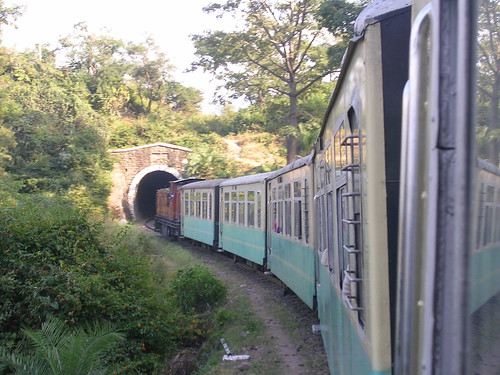
Train from Kalka to Shimla (Toy Train)


India Trip, originally uploaded by sunpreet28.

I went to shimla in November of 2006, I think one day after Diwali. Our tickets were not confirmed from Kalka to Shimla. We took 2 tier AC from New Delhi and went to Kalka. I must admit that the Delhi Railway station was in very bad condition. You could see people lieing on the ground and it was full of people.

I ate a dish made with milk I don’t remember the name, but it was like yogurt. It was really good and was served in Kullars. We waiting and waiting and finally I saw train coming on the platform. We were not able to locate our seat and when we were oh god, it was full and we had the top births. Anyway it was night so I tried to sleep but couldn’t as I was worried about the money and stuff I am carrying. I couldn’t sleep properly and we were at Kalka at around 6 am. When we came out I noticed that I dropped my Cell phone in the train and I had to run back and fortunately it was there and I got it.

It was critical point of getting a seat in the train. We couldn’t get any seats as people just took all available seats and we jumped into 3rd class and had to sit on benches. My uncle who went with me to shimla is an retired railway officer. He was at some higher post so he talked to Ticket Collector, and we made an arrangement with him. We got moved to first class now with a payment of Rs. 200 to TT. It's about $5. Anyways we shared our own cabin with some Bangali family.

They were nice and I guess were not from India. We enjoyed our journey and I took so many pictures and for more pictures must visit my website at www.flickr.com/sunpreet28.
Train stopped at Barog station and we bought the very famous veggie cutlets. There were so many tunnels on the way. Someone was saying it has the highest number of tunnels in the world and India’s biggest or may be worlds.

Some people must be taking advantage of going in the dark, especially newly weds. There were so many nice stations and they were well maintained. One cannot say they were in India. Nice flowers and clean and not a lot of people. I actually enjoy my train trip from kalka to Shimla.

The Kalka Shimla Railway line is one of the most popular hill railway in India. The trains running on these tracks, are popularly called 'Toy Trains'. A journey on this railway is a unique experience as one passes through the breathtaking landscape of the majestic Himalayas, through tunnels and over bridges; amid the lush green valleys embellished with pine and oak trees. The traveller is left with a long lasting memory of rhapsody and triumph.

The Kalka Shimla railway line was inaugurated by the British Viceroy, Lord Curzon in November 1903, covering the distance of 96 km from Kalka through the curving tracks, up to Shimla hills- the summer capital of colonial India. The toy train passes through 102 tunnels (originally 103), 969 bridges, 919 curves and 20 railway stations in its entire journey. The Guinness Book on 'Rail Facts and Feats' included Kalka-Shimla Railway as the greatest narrow gauge engineering achievement in India.

Kalka Shimla Toy Train has about 07 coaches that can accommodate around 200 passengers in a single trip. The 700 horsepower B-B type diesel engines run energetically meeting the challenge of hazardous and adverse weather conditions - temperatures ranging from 0 to 45°C, heavy snowfall -average recording 2 feet during winters, and the annual rainfall of 200-250 cm, perceived by the valley. The train acquires up a moderate average speed of 25-30 km throughout its journey enabling its travelers to soak in the beauty of the picturesque valley.

An interesting feature of the Kalka-Shimla Railway is the almost complete absence of Girder bridges. Multi arched galleries like ancient roman aqueducts being the commonest means of carrying the line over the ravines between the hills spur. There is only one 60 feet plate girder span in a Pinewood near the old engineer’s bungalow at Dharampur and a steel trestle via duct, which replaced a stone gallery in 1935 in the 869 bridges representing about 3 percent of the line

Monday, June 2, 2008

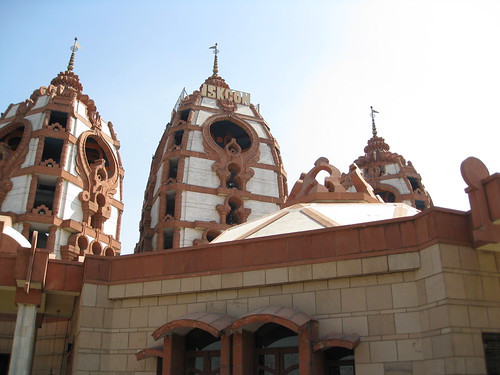
Iskon Temple, New Delhi, India


India Trip Feb 2008, originally uploaded by sunpreet28.

I went to Iskon Temple the same day I went to see Delhi Haat and Lotus Temple. My day was great as I visited Delhi’s most famous tourist spots. You feel good when you visit Iskon and Lotus Temple. Actually I went there in March of 2008 and it was very hot at that time. I walked from Iskon Temple to Lotus Temple. Auto charged us I think Rs. 20 from Delhi Haat to Iskon Temple. It is really nice temple and I believe lots of Europeans follow this religion now. Temple was huge and well maintained. Iskon Temple has a sweet shop and you can try Indian sweets and some snacks at cheaper price.

The International Society for Krishna Consciousness (ISKCON), also known as 'the Hare Krishna' movement, was founded in 1966 in New York City by A.C. Bhaktivedanta Swami Prabhupada. While some classified it as a new religious movement, its core philosophy is based on scriptures such as the Bhagavad-Gita and Srimad Bhagavatam,[1] both of which date back more than two millennia. The distinctive appearance of the movement and its culture come from the Gaudiya Vaishnava tradition, which has had adherents in India ever since the late 1400s. Early converts to the movement were dated to early 1930s.[2]

Non-sectarian in its ideals, [3] ISKCON was formed to spread the practice of Bhakti yoga (The Yoga of Devotion), in which aspirant devotees (Bhaktas) dedicate their thoughts and actions towards pleasing the Supreme Lord, Krishna (seen as non-different from God).[4][5]ISKCON today is a worldwide confederation of more than 400 centres, including 60 farm communities some aiming for self-sufficiency, 50 schools and 60 restaurants. In India society expansion has unsurprisingly perhaps the most rapid.
Philosophy and history
For further information see: Achintya Bheda Abheda and Gaudiya Vaishnavism
Devotees in ISKCON worship Krishna as the highest form of God, and often refer to him as "the Supreme Personality of Godhead" in writing, which was a phrase coined by Srila Prabhupada in his books on the subject. Devotees consider Radha to be Krishna's divine female counterpart, the embodiment of love. An important aspect of their philosophy is the belief that the individual soul is an eternal personal identity which does not ultimately merge into any formless light or void as suggested by the monistic (Advaita) schools of Hinduism.

Hare Krishna devotees specifically follow a disciplic line of Gaudiya, or Bengali, Bhagavata Vaishnavas which comes under the general description of Gaudiya Vaishnavism. Vaishnavism means 'worship of Vishnu', and Gauḍa refers to the area where this particular branch of Vaishnavism is practiced and is widespread, among other places, such as Rajastan and Vrindavana. Gaudiya Vaishnavism has had a continuous following in India, especially West Bengal and Orissa for the past five hundred years. Srila Prabhupada disseminated Gaudiya Vaishnava Theology in the Western world through extensive writings and translations,[7] including Bhagavad Gita[4], Srimad Bhagavatam (Bhagavata Purana)[5] and Chaitanya Charitamrita[6] and other scriptures. These works are now available in more than seventy languages and serve as the canon of ISKCON. Many of these books are now available online from a number of websites.[8] [9]

Early western conversions to monotheistic Krishna vaisnavism or Bhagavata Vaishnava line, that forms the basis of ISKCON philosophy, were recorded by the Greeks and survived as archeological monuments.[10] [11]


[edit] Maha Mantra
Main article: Hare Krishna Mantra
The popular nickname of "Hare Krishnas" for devotees of this movement comes from the mantra that devotees sing aloud or chant quietly on rosary-like beads, called Japa mala. This mantra, known also as the Maha Mantra, contains the names of God Hare, Krishna and Rama. Devotees believe that the sound vibration created by repeating these names of God gradually revives a state of pure God-consciousness, or "Krishna consciousness."[12]

The Maha Mantra:

Hare Krishna Hare Krishna
Krishna Krishna Hare Hare
Hare Rama Hare Rama
Rama Rama Hare Hare

[edit] Seven purposes of ISKCON

Public street festivals are a significant part of ISKCONs outreach programmes. Seen here is a Ratha Yatra festival in central London.When Srila Prabhupada first incorporated ISKCON in 1966, he gave it seven purposes:[13].

To systematically propagate spiritual knowledge to society at large and to educate all peoples in the techniques of spiritual life in order to check the imbalance of values in life and to achieve real unity and peace in the world.
To propagate a consciousness of Krishna, as it is revealed in the Bhagavad-gita and the Srimad-Bhagavatam.
To bring the members of the Society together with each other and nearer to Krishna, the prime entity, thus to develop the idea within the members, and humanity at large, that each soul is part and parcel of the quality of Godhead (Krishna).
To teach and encourage the sankirtana movement, congregational chanting of the holy names of God as revealed in the teachings of Lord Sri Chaitanya Mahaprabhu.
To erect for the members, and for society at large, a holy place of transcendental pastimes, dedicated to the personality of Krishna.
To bring the members closer together for the purpose of teaching a simpler and more natural way of life.
With a view towards achieving the aforementioned purposes, to publish and distribute periodicals, magazines, books and other writings.

[edit] Four regulative principles
Srila Prabhupada prescribed four regulative principles as the basis of the spiritual life:

No eating of meat, fish or eggs
No illicit sex
No gambling
No intoxication (including alcohol, caffeine and tobacco).

[edit] Preaching activities

ISKCON Temple in Tirupathi, IndiaISKCON is actively evangelistic. Members try to spread Krishna consciousness, primarily by singing the Hare Krishna mantra in public places and by selling books written by A. C. Bhaktivedanta Swami Prabhupada.[14] Both of these activities are known within the movement as Sankirtan. According to the doctrine of Chaitanya Mahaprabhu, one does not need to be born in a Hindu family to take up the practice of Vaishnavism. This philosophy places ISKCON in strong contrast to many other branches of Hinduism, which may stress hereditary lineage and are non-missionary by nature. There are ISKCON communities around the world with schools, restaurants and farms. In general, funds collected by ISKCON are treated as communal property and used to support the community as a whole and to promote the preaching mission.[15] Many temples also have programs (like Food for Life Global) to provide meals for the needy. Also, ISKCON has recently brought the academic study of Krishna into western academia as Krishnology.


[edit] Food for Life
Main article: Food for Life
ISKCON has inspired, and sometimes sponsored, a project called Food for Life. The goal of the project is to "liberally distribute pure vegetarian meals (prasadam) throughout the world", as inspired by Prabhupada's instruction, given to his disciples in 1974, "No one within ten miles of a temple should go hungry . . . I want you to immediately begin serving food".[16] A global charity, directed by Paul Turner and Mukunda Goswami,[17] coordinates the project. Food for Life is currently active in over sixty countries and purports to serve over 700,000 meals every day.[18] Its welfare achievements have been noted by a number of journals worldwide.[19][20][21][22]


[edit] Management structure

ISKCON Temple in Delhi, IndiaSrila Prabhupada spent much of the last decade of his life setting up the institution of ISKCON. As a charismatic leader, Srila Prabhupada's personality and management had been responsible for much of the growth of ISKCON and the reach of his mission.[23][24]

The Governing Body Commission (or GBC) was created by Prabhupada in 1970. According to the letter of 28th July 1970 Prabhupada appointed following members to the commission, all of them non sannyasi: [23]

1. Śrīmān Rupanuga Das Adhikary
2. Śrīmān Bhagavandas Adhikary
3. Śrīmān Syamsundar Das Adhikary
4. Śrīmān Satsvarupa Das Adhikary
5. Śrīmān Karandhar Das Adhikary
6. Śrīmān Hansadutta Das Adhikary
7. Śrīmān Tamala Kṛṣṇa Das Adhikary
8. Śrīmān Sudama Das Adhikary
9. Śrīmān Bali Mardan Das Brahmacary
10. Śrīmān Jagadisa Das Adhikary
11. Śrīmān Hayagriva Das Adhikary
12. Śrīmān Kṛṣṇadas Adhikary
The letter outlines the following purposes of the commission: 1) improving the standard of temple management, 2) spread of Krishna consciousness, 3) distribution of books and literature, 4) opening new centers, 5) education of the devotees. [25] GBC has since grown in size to include 48 senior members from the movement[26] who make decisions based on consensus of opinion rather than any one person having ultimate authority. It has continued to manage affairs since Prabhupada's passing in 1977.[23]


[edit] Influential leaders since 1977
Upon Prabhupada's death on November 14, 1977, eleven of his disciples became initiating gurus for ISKCON: Satsvarupa dasa Goswami [27], Jayapataka Swami [28], Hridayananda dasa Goswami, Tamal Krishna Goswami [29], Bhavananda Goswami, Hansadutta Swami, Ramesvara Swami, Harikesa Swami, Bhagavan dasa Adhikari, Kirtanananda Swami, and Jayatirtha dasa Adhikari.

Of these eleven, the first three have remained as prominent leaders within the movement, as was Tamal Krishna Goswami until his death in a car accident in March 2002. Bhavananda no longer holds the post of an initiating guru but is still involved with preaching activities. Ramesvara and Harikesa resigned as spiritual leaders in 1987 and 1999 respectively and the remaining four were all expelled from the movement by the Governing Body Commission during turbulent times in the 1980s.[30] Of Prabhupada's disciples, which number some 5,000 in total[31] approximately 70 are now acting as diksha gurus within ISKCON.[32]

As of March 2008, Ramai Swami is the chairman of ISKCON's Governing Body Commission. [33]

For further information see: Disciples of A. C. Bhaktivedanta Swami.


[edit] Internal problems and controversy
In the years following Prabhupada's death in November 1977, a number of theological controversies arose:[34]


[edit] Origin of the soul
Srila Prabhupada explains that the soul falls from the spiritual world to this material world and that the supreme objective of the human life is to become Krishna conscious to be able to return "Back to Godhead" (also the title of the official ISKCON magazine). However, some Sarasvata Gaudiya Vaisnavas also teach that the soul has never been in the spiritual world. Discussions about these apparently contradictory views are available in the book Our Original Position published by GBC Press and the article "Where Do the Fallen Souls Fall From?" [35]


[edit] The Guru and the Parampara
ISKCON adheres to the traditional system of paramparā, or disciplic succession, in which teachings upheld by scriptures are handed down from master to disciple, generation after generation.[36] A minority of people who express faith in Srila Prabhupada's teachings say that Srila Prabhupada, in contrast to the tradition, intended that after his physical demise he would continue to initiate disciples through ceremonial priests, called ritviks. One version of this idea is espoused by a group calling itself the ISKCON Revival Movement.[37] ISKCON's Governing Body Commission has rejected all such ideas.[38]


[edit] Issues within the society
ISKCON also experienced a number of significant internal problems, the majority of which occurred from the late seventies onwards, and especially within the decade following Prabhupada's death.[39]

In 1976 a case involving allegations of "brainwashing" involving a minor named Robin George and her parents went all the way to the Supreme Court of the United States. In 1983, a California jury awarded the family more than $32 million in damages for false imprisonment and other charges, which was reduced to $485,000 in 1993.[40][41].

Also ISKCON has been subject matter of discussion at some anti-cult movements.[42][43][44]

Currently for an exception of a few countries, such as some in the islamic world, the Hare Krishna movement is accepted by the academics as "the most genuinely Hindu of all the many Indian movements in the West".[45]

Stories of physical, emotional, and sexual abuse of children at the society's boarding schools in India and America began to emerge in the 1980s, with cases dating back from the mid-1970's onwards.[46] Some of these cases later appeared in print, such as in John Hubner and Lindsay Gruson's 1988 book Monkey on a Stick. In 1998 an official publication produced by ISKCON detailed the physical, emotional, and sexual abuse of children at the society's boarding schools in both India and the U.S. during the 1970s and 1980s.[47] The group received praise for its candor but later was sued by 95 people who had attended the schools.

Facing the fiscal drain likely to ensue from this legal action, the ISKCON centers involved declared Chapter 11 bankruptcy. This allowed them to work out a settlement of US$9.5 million, meant to compensate not only the former students who had brought the suit but also any others who had undergone abuse but had not sued.[48] About 430 such people responded to newspaper advertisements seeking to identify them. Individual victims are expected to receive between $6,000 and $50,000, depending on the nature and duration of their abuse.

To guard against further abuses, ISKCON has established a child protection office with teams worldwide, meant to screen out actual or potential abusers, educate children and adults on child abuse, and encourage due vigilance.[49] A petition circulating (as of July 2006) among ISKCON members calls for "zero tolerance" for past offenders.[50]

In 1990 US Courts pronounced Kirtanananda Swami, the leader of the 'New Vrindavan' religious community (which was expelled from ISKCON for ten years between 1988-1998) [51] guilty on charges of racketeering and conspiracy to murder for his role in the death of two devotees (Steven Bryant and Charles Saint Denis) who had threatened his control of the community. Kirtanananda was sentenced to 20 years in prison on the racketeering charge, but was released in June 2004 for health reasons.

In response to the need to establish transparency and accountability among its members, ISKCON encouraged the establishment of an ombudsman organization, ISKCON Resolve.[52] This Integrated Conflict Management System (ICMS) also provides facilitators, arbitrators, and conflict analysis experts to help ISKCON members deal with internal disputes and concerns. The Resolve organisation states that its aims are to give all members of ISKCON a voice and to bring the ISKCON leadership to higher levels of transparency and accountability.


[edit] Rath Yatra controversy

An ISKCON Rath Yatra festival in New York City, USAISKCON organises Rath Yatra festivals in different countries around the world, including India. Although held once annually in each location, these festivals occur on different dates throughout the summertime, which is marked difference from the Rath Yatra as held at the Jagannatha temple in Puri (where the festival originates). At this temple, the Rath Yatra festival is held once each year on a specific date in July, and complaints have recently been made regarding ISKCON's having their international festivals at significantly different times to this.[53] On December 20, 2007 the Puri priests held a demonstration demanding a ban on entry of ISKCON monks and alleging "a number of foreigners under the cover of ISKCON were trying to enter the temple", which is not allowed as per temple tradition (only Hindus of Indian racial origin are allowed into the temple).[54]. The validity of this temple policy has been questioned in the media on a number of occasions,[55][56] with one case in November 2007 notably involving members of ISKCON.[57]

Delhi Haat, New Delhi, India


India Trip Feb 2008, originally uploaded by sunpreet28.

Dilli Haat is a combination food plaza and craft bazaar located in the heart of Delhi. Near All India Institute of Medical Sciences, opposite INA Market, Dilli Haat has stalls representing each state of India, giving complete variety of tastes available all over India. There are also stalls of crafts from all over India, and from a variety of cultural traditions of India. Around 2003, this market became fully wheelchair-accessible, including an accessible bathroom.[1][2][3] This is a relative rarity in India.

There are plans to open more Dilli Haats all over Delhi.

Unlike the traditional weekly market, the village Haat, Dilli Haat is permanent. Some shops are permanent but other sellers are rotatated, usually for fifteen days.[4] Products offered may include rosewood and sandalwood carvings, embellished camel hide footwear, sophisticated fabric and drapery, gems, beads, brassware, metal crafts, and silk and wool fabrics. Shows promoting handicrafts and handlooms are held at the exhibition hall in the complex. To sell wares, there is an application process and spaces are allocated according to which state the seller is from.[5]

There is a nominal entrance fee to shop at Dilli Haat.[

The craftsmen who are registered with D.C.Handicrafts are the ones who are eligible to find a place here. The 62 stalls selling handicrafts are allotted on a rotational basis to craftsmen who come from all corners of the vast & varied land of India at a payment of mere INR 100 per day for a maximum period of 15 Days. This ensures visitors buy authentic wares at prices that have not been inflated by high maintenance costs.

You can also savour the inimitable flavors of the delightful local foods from the various regions of India be it the momos from Sikkim or the Bamboos hot chicken from Nagaland, Kahwa & Kebabs from Jammu, Pooranpoli from Maharastra or the Gujrati Dhokla. As many as 25 food stalls offer you variety of foods served in an Eco friendly manner.

The DILLI HAAT provides the ambience of a traditional Rural Haat or village market, but one suited for more contemporary needs. Here one sees a synthesis of crafts, food ad cultural activity.

This Food and Craft Bazar is a treasure house of Indian culture, handicrafts and ethnic cuisine, A unique bazaar, in the heart of the city, it displays the richness of Indian culture on a permanent basis.

Steps inside the complex for an altogether delightful experience by either buying inimitable ethnic wares, savouring the delicacies of different states or by simply relaxing in the evening with the entire family.

DILLI HAAT transports you to the magical world of Indian art and heritage presented through a fascinating panorama of craft, cuisine and cultural activities.

While the village haat is mobile, flexible arrangement, here it is crafts persons who are mobile. The DILLI HAAT boasts of nearly 200 craft stalls selling native, utilitarian and ethnic products from all over the country.

An ambitious project, set up jointly by Delhi tourism and NDMC, D.C. (Handicrafts) & D.C. (handlooms), Ministry of Textiles, Govt. of India & Ministry of Tourism, Govt. of India. It aims at providing encouragement to the needy artists from all over the country in order to sustain and preserve the rich heritage of India.

While allowing free interaction between buyers and sellers, the organizers favour a check on prices to keep them moderate.

Different and appealing, DILLI HAAT is located in one of the most important commercial centers of South Delhi, opposite INA market. The 6 acres of land on which this sprawling complex is situated was salvaged as part of a reclamation project and transformed into a magnificent dream plaza. Extensive foundation work, small thatched roof cottages and kiosks with a village atmosphere have made the place into an attractive multiple centers.


The word Haat refers to a weekly market in rural, semi-urban and sometimes even urban India.

DILLI HAAT is not just a market place; it has been visualized as a showpiece of traditional Indian culture- a forum where rural life and folk art are brought closer to an urban clientele.

It is here that the crafts persons find an opportunity to demonstrate their artistic skills to thousands of visitors everyday.

Since its inauguration in the month of March 1994, Dilli Haat has been home to nearly 50,000 handicraft and handloom artisans. The sales generated, so far, are estimated at Rupees three hundred crores.

The complex is not only artistic, but also recreational in nature where the entire family can have a good time.

It is a place where one can unwind in the evening and relish a wide variety of cuisine without paying the exhorbitant rates.

Besides an International Food Plaza there are 25 stalls dishing out sumptuous delicacies from different States and Union Territories; and Exhibition Hall; a Souvenir shop selling an assortment of small gift items; an assortment of small gift items; an open stage for cultural programmes and a playing area exclusively earmarked for children.

Architecture

The architectural features of the complex have been especially designed in the traditional north Indian style, with brickwork jail (lattice) and stone roofs.

A hall in the complex caters specifically to exhibitions of the handlooms and handicrafts. A souvenir shop, also displays attractive ethnic products.

The small thatched roof cottages and kiosks, without any concrete structures provide a village atmosphere.

The shops are set up on platforms, which act as a link in the Bazar design. The courtyards between the shops are paved in stone and interspaced with grass to retain a visual softness.

The landscaping of the area incorporates colourful flowering shrubs and trees, thus the entire complex is in harmony with the environment


Tickets

Cost of ticket is Rs.15/- for adult and Rs.5/- for child.


for more information, please contact
Delhi Haat,INA, Aurbindo Marg,
New Delhi
Ph: 011-26119055, 24678817

Delhi Haat, Pitam Pura (Near TV Tower),
New Delhi,
Ph: 011-64690443

My Visit to Delhi Haat was a good experience. I asked my buddy to buy the ticket for me and we went in the morning. Most of the shops were open but there were not a lot of tourists. All the stuff was from different states and once can buy things from different parts of India at this place. it had some nice collector items. I checked out various shops. There is some nice variety of clothes and I must say that bargaining is must. You have to be a professional bargainer or you end up paying a lot. 80 % of the people visit Delhi Haat is tourists from different countries, mostly Europeans.
I would also recommend going to Iskon Temple and Lotus Temple which is not too far from this place.